I Thought Menopause Was Just Hot Flashes. Then My Stomach Completely Shut Down.
GlowGreen
Sponsored content from GlowGreen
I Thought Menopause Was Just Hot Flashes. Then My Stomach Completely Shut Down.
Three doctors told me my bloodwork was “normal.” Nobody mentioned that menopause might be affecting my digestion this much — or that there was a $60 supplement option I wanted to try.

Picture this: It’s 2:30 in the morning. You’re on the bathroom floor in your pajamas, knees pulled into your chest, stomach cramping so hard you can’t stand up straight. You ate chicken and vegetables for dinner. A meal you’ve eaten a thousand times. And your body is treating it like you swallowed glass.
Your husband is sleeping. Your kids don’t know. You’re sitting on cold tile, typing into Google with shaking hands: “why can’t I digest food anymore at 50”

Nobody told you menopause would do this. The hot flashes, sure. The mood swings, the weight gain — you expected that. But this? This violent, unpredictable, embarrassing war with your own stomach? Nobody warned you about this part. And it wasn't just the digestion. The brain fog hit me like a wall — I'd stand in the kitchen and forget why I walked in there. I couldn't finish sentences. I thought I was losing my mind.
I'd gained over 20 pounds despite eating better than I had in my twenties. My belly fat wouldn't budge no matter what I tried — not the walking, not the salads, not the intermittent fasting. I felt 70 at 52. I looked in the mirror and didn't recognize myself. My daughter told me I looked “exhausted all the time.” My doctor suggested I might be depressed and offered me an antidepressant. I wasn't depressed. I was exhausted by symptoms nobody was clearly connecting.
That was me. Fourteen months ago. Sitting on that bathroom floor, convinced something was seriously wrong with me. Terrified of the word “cancer.” Wondering how a body that worked perfectly fine for 49 years could just… stop.
Let me tell you what I found out — and why I wish someone had told me sooner.
The Part of Menopause Nobody Talks About
It started at 48. Subtle at first. A little bloating after meals I’d eaten my whole life. Bread made me puffy. Dairy made me gassy. Wine — my one glass of wine with dinner — suddenly left me feeling like I’d swallowed a balloon.
I ignored it for months. “I’m just getting older,” I told myself. “This is what happens.”
But it didn’t stop. It got worse. By 49, I was bloating so badly by lunchtime that a woman at Target asked me when I was due. I’m not pregnant. I’m perimenopausal and my digestion suddenly felt completely out of sync.
I gained 15 pounds — all of it around my midsection. The “menopause belly” that appeared overnight and wouldn’t leave no matter what I did. Half my wardrobe stopped fitting. I was cancelling dinner plans because I couldn’t predict when the bloating would hit. I started sitting on the aisle at restaurants so I could get to the bathroom fast. I stopped riding in other people’s cars.
My life was shrinking, meal by meal.
Three Doctors. Zero Answers.
I went to my primary care doctor first. She ran bloodwork. Everything was “normal.” She told me to eat more fiber and drink more water. When I told her about the brain fog and the weight gain too, she looked at me like I was checking off a list of complaints. “It's not depression, is it?” she asked. No. It's not depression. It's my hormones dismantling my body and you can't see it on a blood panel.
The fiber made it worse. Significantly worse. I went from bloated to so distended my husband asked if I needed the ER.
I saw a gastroenterologist. He ran more tests. Colonoscopy: normal. Endoscopy: normal. “You might have IBS,” he said. “Try a low-FODMAP diet.”
I tried the low-FODMAP diet for six weeks. I eliminated gluten, dairy, onions, garlic, beans, apples, and about forty other foods I used to eat without thinking. The bloating reduced maybe 20%. I was miserable, hungry, and socially isolated. You can’t eat at a restaurant on a low-FODMAP diet. You can’t go to a dinner party. You spend your whole life thinking about food — not enjoying it, but fearing it.
The third doctor — a women’s health specialist — finally said the word nobody else had said: “This is hormonal.”
But her only suggestion was HRT. I didn’t want hormones. My mother had breast cancer. I wasn’t willing to take that risk. So she shrugged and said, “It might just be something you have to live with.”
Three doctors. Thousands of dollars in tests. Six weeks of elimination dieting. And the best answer modern medicine could give me was: “Live with it.”
I refused to accept that.The Supplement Graveyard Under My Sink
When doctors fail you, you become your own researcher. Late nights. Reddit threads. Facebook groups. Amazon reviews. You try everything because no one is helping you and you’re desperate.
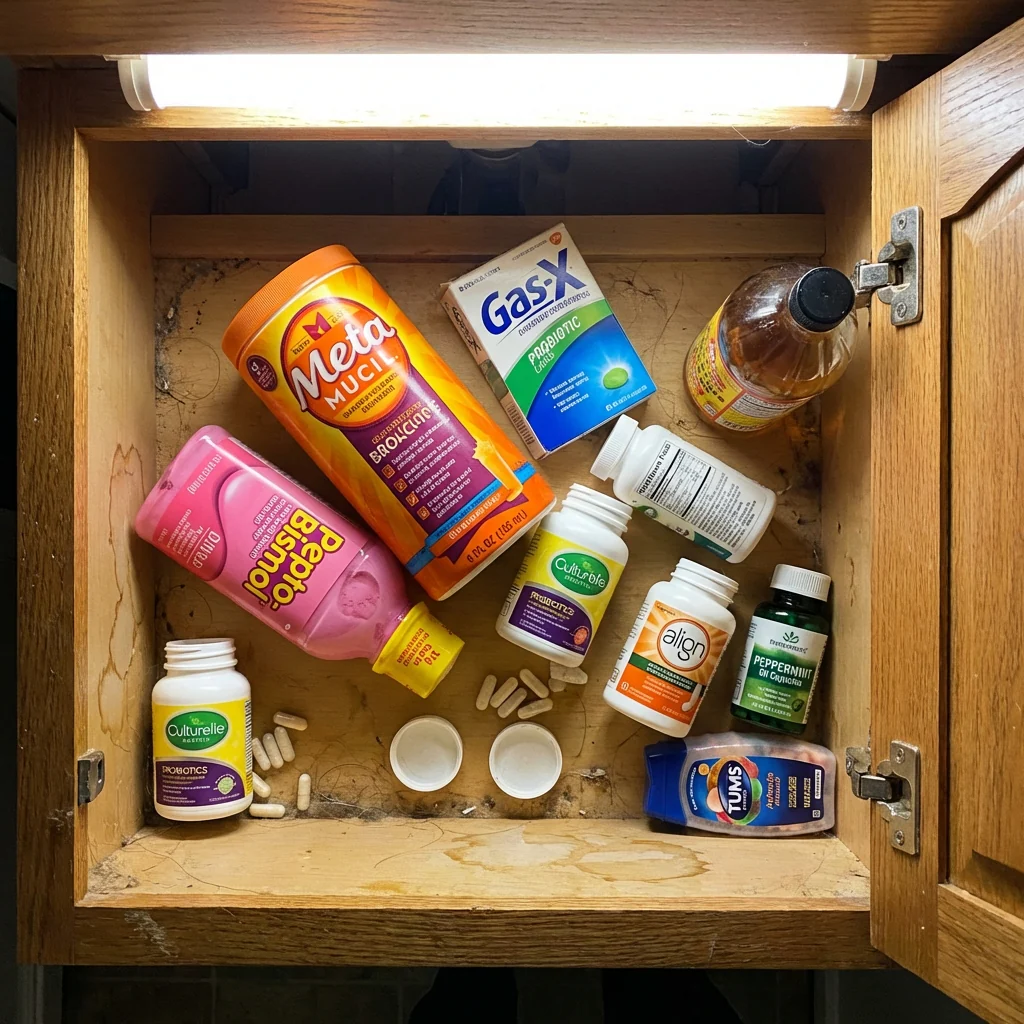
Under my bathroom sink, January 2026. Eleven months. Seven approaches. Zero results.
- Probiotics — four different brands ($50/month for Seed alone) — Each one helped for about a week. Then nothing. My cabinet became a graveyard of half-used probiotic bottles. Align, Culturelle, Garden of Life, Seed. None of them addressed what was actually happening.
- Digestive enzyme blends (generic pharmacy brands) — Weak formulas that barely made a dent. I’d take three capsules and still bloat after every meal. The dosage was too low and the enzyme profile was wrong for what my body actually needed.
- Apple cider vinegar (daily for three months) — Burned my throat. Did nothing for the bloating. Gave me acid reflux on top of everything else. The internet swore by it. My stomach disagreed.
- Fiber supplements (Metamucil, Benefiber) — Made the bloating dramatically worse. My doctor recommended these. They were the worst thing I tried. Like adding cement to a pipe that’s already clogged.
- Peppermint oil capsules — Slight reduction in gas. The bloating itself? Completely unchanged. The 2am bathroom trips? Still happening.
- Gas-X, Beano, Tums — the whole OTC aisle — Band-aids. Temporary. Like putting a tiny bandage on a broken leg. They treated the symptom for an hour and the cause continued unchecked.
- Elimination diets (gluten-free, dairy-free, low-FODMAP) — The most restrictive made the most difference — about 20%. But the cost was my social life, my enjoyment of food, and my sanity. That’s not a solution. That’s a prison sentence.
Seven approaches. Over $500 spent. Eleven months of my life. The bloating remained. The 2am floor sessions continued. The shame grew.
The Conversation That Changed Everything
It happened at book club. February. I was sitting in Lisa’s living room, and I’d already unbuttoned my jeans under my sweater because the bloating had started 20 minutes after the appetizers.
Karen — 53, also perimenopausal — was eating crackers and hummus like it was nothing. I watched her eat three servings. No bloating. No discomfort. No hand on her stomach. No quiet exit to the bathroom.

Six months earlier, she’d been worse than me. She’d told me she’d stopped going to restaurants entirely.
“What changed?” I asked her quietly, so the group wouldn’t hear.
She pulled me aside and explained something that made every single failed supplement, every useless doctor visit, every wasted dollar suddenly make sense.
Suddenly, every failed experiment made more sense to me. The probiotics didn't feel like enough because they were adding bacteria to a gut environment that still felt unsettled. The fiber felt like it was adding bulk to a system that already seemed slow. The elimination diets partly helped because they removed harder-to-digest foods, but they still didn't feel like a complete answer.
What stood out to me was that the issue might not be the foods themselves, but how my body was handling them. My hormones had changed. My digestion felt different. And nothing I’d tried had really addressed that gap in a way that made sense to me.
“So what did you do?” I whispered.
She reached into her purse and pulled out a small green bottle. “Papaya enzyme complex,” she said. “Two capsules before meals. This is what seemed to help me the most.”
Understanding the Digestive Changes I Was Reading About
I went home and spent the next three days researching. I wanted to understand why a papaya enzyme might feel more relevant to me than everything else I had tried. What I found was one possible explanation for how menopause can affect digestion.
That is why probiotics did not feel like enough for me, and why fiber did not feel like the right fit either. Elimination diets partly helped because they removed harder-to-digest foods, but they still did not feel like they addressed the support I was looking for.
For me, enzyme support felt like the missing piece I had not explored carefully enough.
What I Found (and What Changed Everything)
The product Karen had been using was GlowGreen Papaya Seeds Complex. I’d never heard of it. It wasn’t marketed to menopausal women. It didn’t have celebrity endorsements. It was a clean, straightforward digestive enzyme formula that happened to address the exact mechanical problem my body was experiencing.
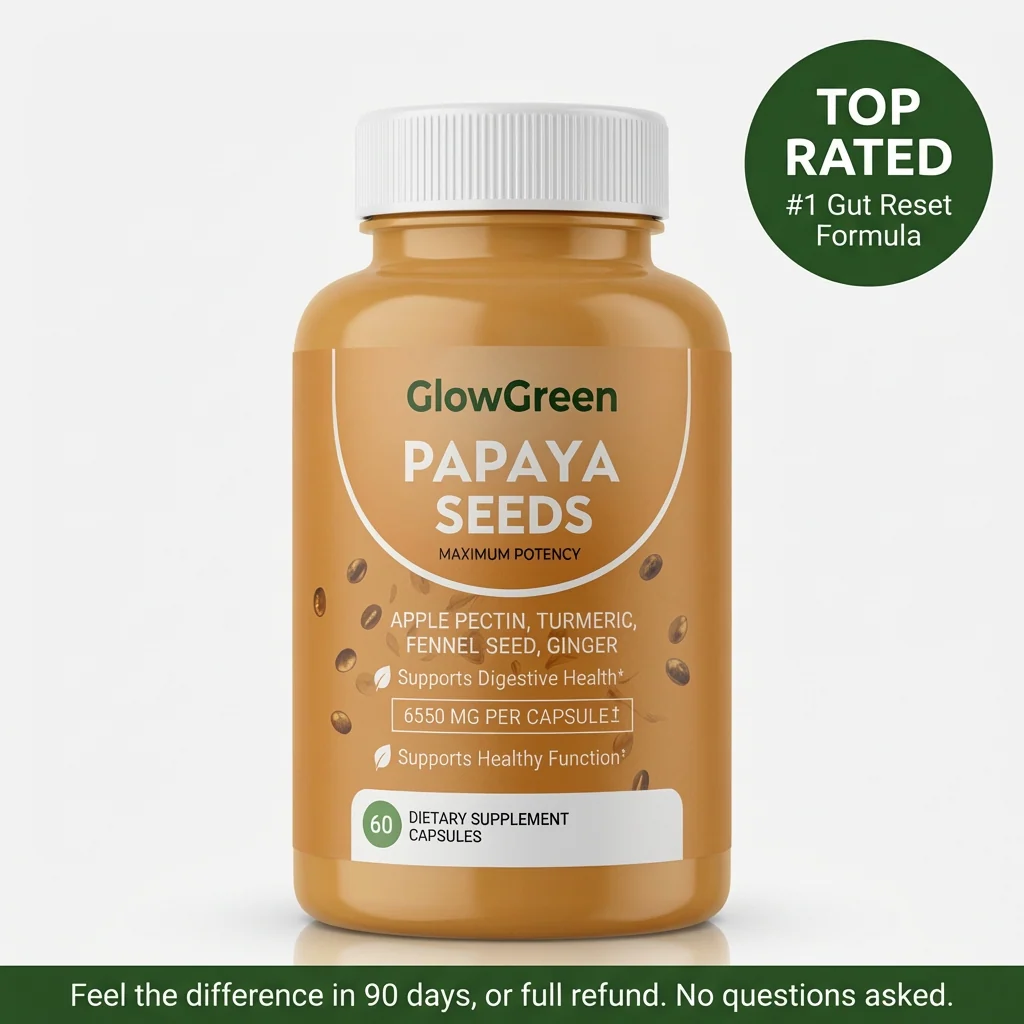
Simple ingredient list. Each one serving a purpose I now understood:
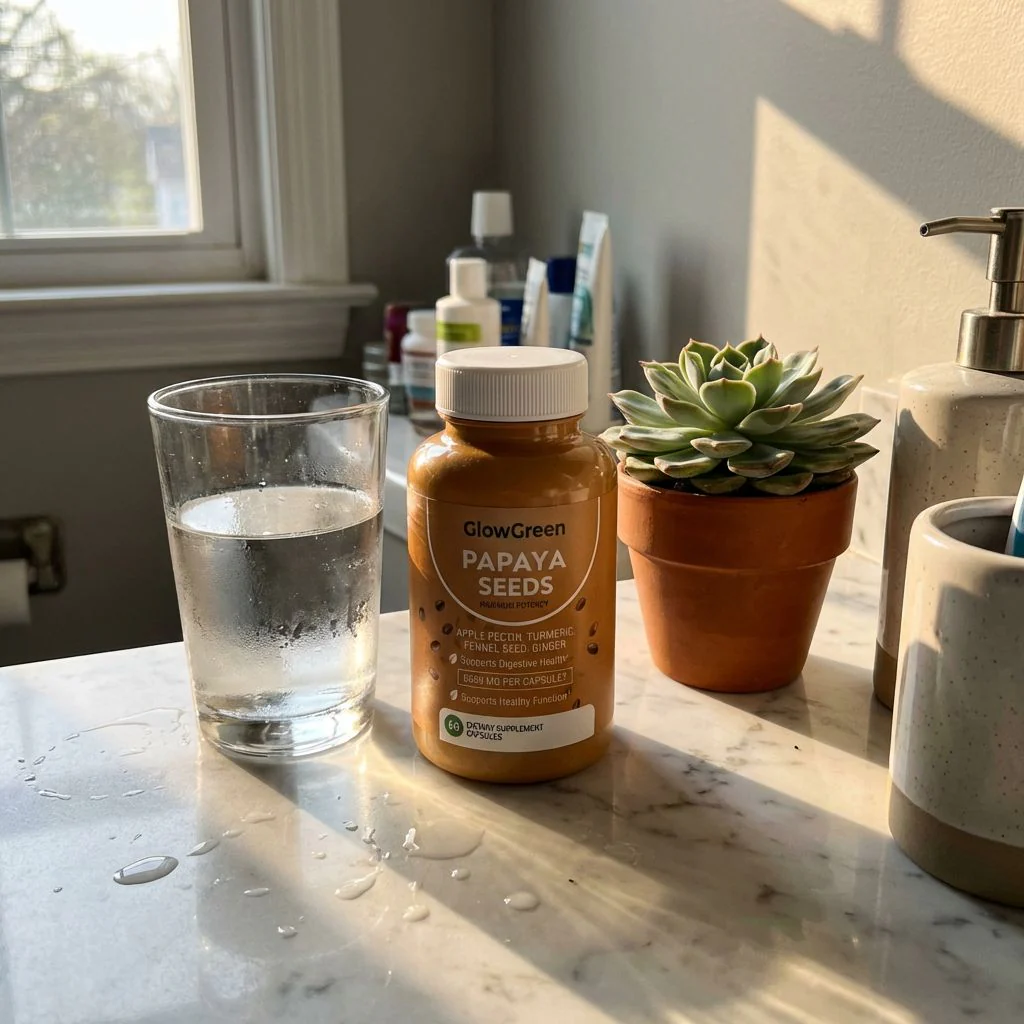
My bathroom counter today. One bottle. That’s it.
I looked under my bathroom sink. The four probiotic bottles. The Metamucil. The Gas-X. The apple cider vinegar. The peppermint capsules. Eleven months of failed experiments. All of it — replaced by one formula containing the one ingredient I’d been missing.
I ordered it that night.
GlowGreen Papaya Seeds Complex • 90-Day Guarantee
*These statements have not been evaluated by the FDA. This product is not intended to diagnose, treat, cure, or prevent any disease. Individual results may vary.
What Happened Over the Next 90 Days
I want to be honest: this wasn’t a miracle overnight cure. My digestion didn’t reset in 48 hours. But over the next twelve weeks, I started noticing gradual changes that made day-to-day life feel more manageable.

Week 3. Salmon with my husband. No excuses. No bathroom escapes. Just dinner.
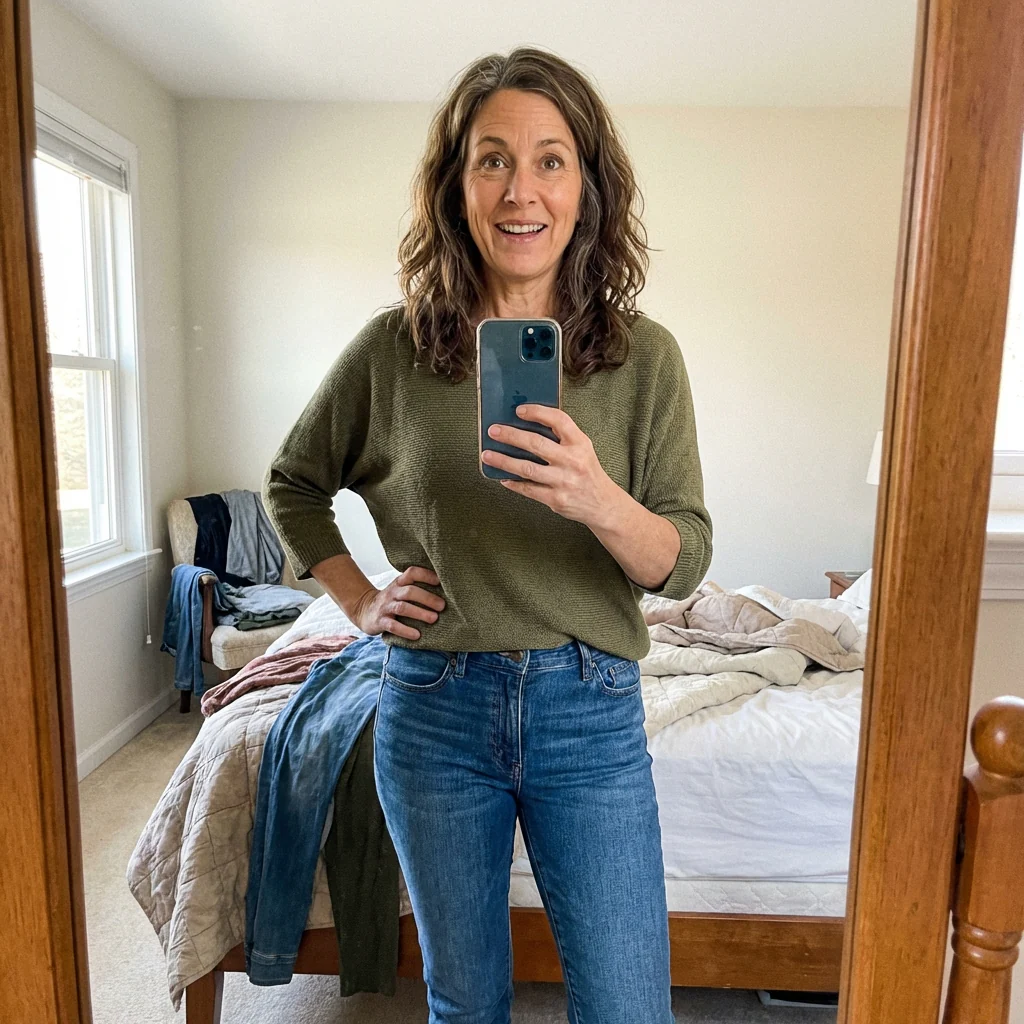
Week 6. The jeans from my 49th birthday. They fit.
Menopause did not disappear, but the digestive discomfort felt much more manageable.
That was the shift: I didn’t have to choose between accepting my hormonal transition and looking for more digestive support. For me, it felt possible to do both at the same time.
Free shipping • 90-day satisfaction guarantee
What This Actually Costs (and What It Replaces)
I added up what I’d spent over eleven months trying to support my digestion with things that didn’t feel helpful:
I was spending $147/month trying to manage symptoms with a rotating cast of products that did not feel well matched to what I was dealing with. Now I spend less than a third of that on something that felt more aligned with the kind of support I wanted to try.
But price isn’t even the point. The point is that this felt like a better fit for me than probiotics, elimination diets, fiber, and antacids had. Even if the cost were identical, I still would have chosen the option that felt easiest to stay consistent with.
You’re Standing at a Crossroads Right Now
If you’re reading this, you’re probably somewhere I was a year ago: In your late 40s or 50s. Watching your body change in ways nobody prepared you for. Bloated by lunch. Afraid of dinner. Cancelling plans. Googling symptoms at 2am. Being told by doctors that everything is “normal” while your life shrinks around you.
You have two paths in front of you:
- → Keep the supplement graveyard under your sink
- → Keep unbuttoning your jeans after lunch
- → Keep cancelling dinner plans at the last minute
- → Keep the 2am bathroom floor sessions
- → Keep hearing “your tests are normal” from doctors who can’t help you
- → Keep watching your wardrobe shrink as your midsection grows
- → Accept that this is “just menopause” and stop fighting
- ✓ One formula I chose to explore as part of my routine
- ✓ 2 capsules before meals — simpler than what you’re doing now
- ✓ Look for steadier digestive support over time
- ✓ Feel more comfortable sitting down to meals
- ✓ Work toward less day-to-day bloating
- ✓ See whether it helps you feel more confident saying yes to plans
- ✓ 90-day guarantee if you want to try it
Free shipping • 90-day guarantee